
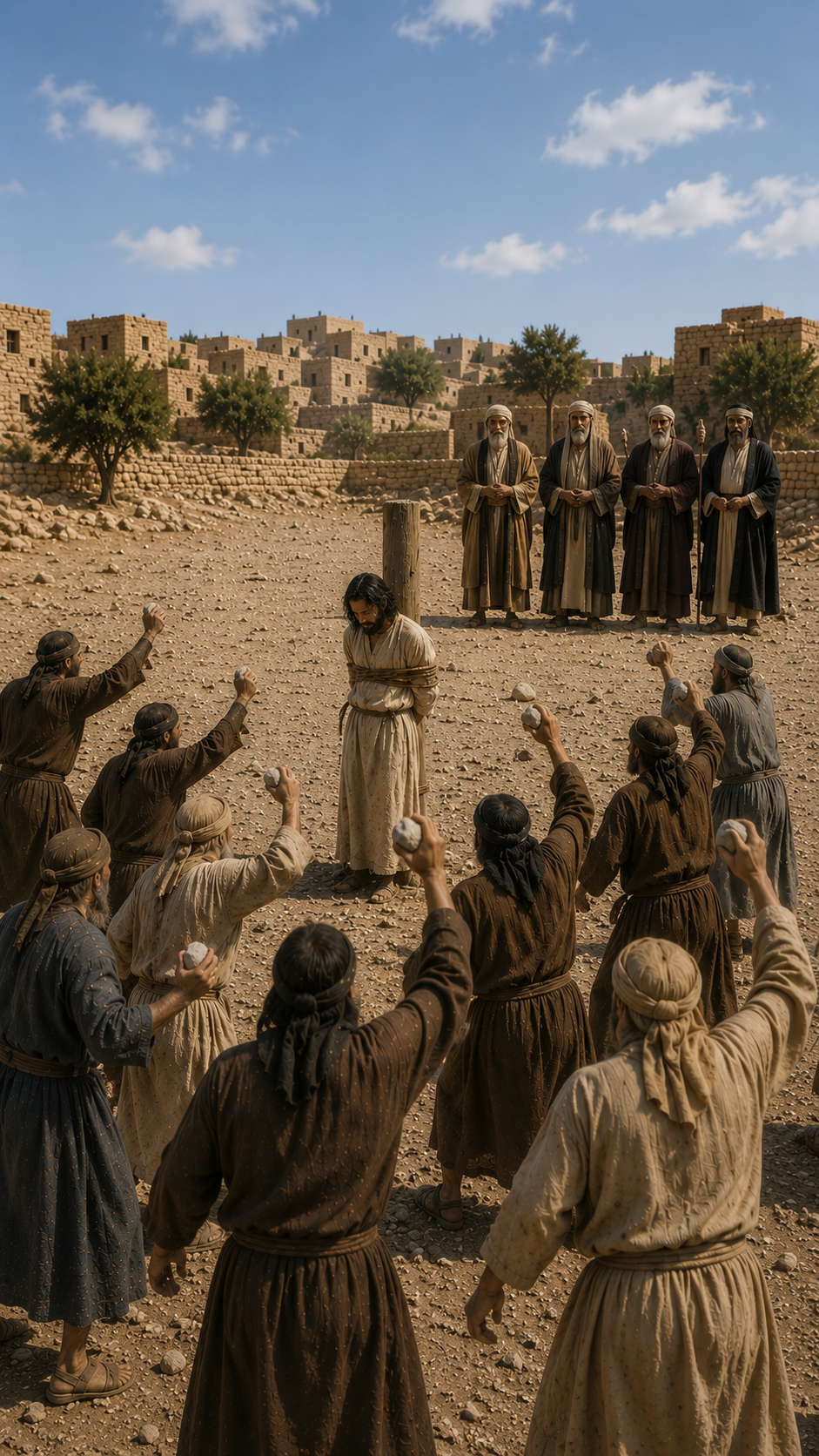
Set forth below is a lightly edited excerpt from chapter 7 of my Come Now, Let Us Reason Together. There I consider the many deeply troubling immoral laws and commandments found in the Pentateuch. I review and reject the solutions offered to date by Jewish theologians. I offer what I regard as a more satisfying alternative, based on Karl Popper’s idea that while we may never know the ultimate truth, we can get ever closer to it by eliminating errors in our existing theories.
* * *
As noted in the introduction, the Torah contains many manifestly horrific commands and laws that cannot be reconciled with humankind’s current moral knowledge, including capital punishment for such victimless crimes as Sabbath desecration, fornication, homosexuality, and so on, and the decree of genocide not just against the Amalekites but also their descendants down through the ages. These passages have led many thoughtful people to a conclusion like the one voiced by Professor Dan Baras, a contemporary academic philosopher: “The Torah includes immoral norms, including norms that unjustly harm people, and it inculcates harmful values.”
This chapter will examine a range of popular responses that have been offered by leading Jewish theologians to this devastating accusation and explain why they are unsatisfactory. Instead, these immoral commands should be conceptualized from the critical rationalist perspective that sees persistent error, including in ethics, as an unavoidable step in getting closer to the truth…..
The Crux of the Problem. In order to understand the grave difficulty rabbis and scholars across the theological spectrum have in formulating an acceptable apology for the Torah’s repellent commandments, it is necessary to appreciate its source. Given the current state of Jewish philosophy, there seems to be an inescapable trade-off between distancing God from the Torah’s abhorrent mitzvot by revisionist accounts of Revelation and deflating one’s conception of him as the awesome, omnipotent God of Abraham, Isaac, and Jacob. In other words, to the extent these odious mandates are understood as God’s eternal will, expressed at Sinai, it becomes increasingly difficult to defend the idea of his perfect justice. Conversely, if such commands are the mere norms of the ancient Israelites subsequently recorded in the Pentateuch by human authors, it invites the question why this is not also the case with respect to the progressive aspects of the Torah, and thus God fades into the metaphysical background….
An Alternative Explanation. Approaching the Hebrew Bible as a corpus grounded in critical rationalism and respect for autonomy resolves many of the apparent anomalies that plague the theories outlined above (I use “Hebrew Bible” here because, as argued in chapter 1, contrary to Chazal’s stance, there is no ontological distinction in the holiness of the various canonical texts). This strategy avoids the trade-off between excusing God for the Torah’s horrific mitzvot and dramatically reducing his omnipotence, and thus our reverence. One can readily admit the immorality of certain mitzvot because there is a benign explanation.
That is, out of respect for the supreme value of moral autonomy, God elected to accept his chosen people where they stood, moral warts and all. Rather than instantly accelerate their progress to some arbitrary point along an infinite continuum, he gave them—and through them, all of humanity—a road map that would guide them to their final destination with a set of liberal values that honor persons as moral agents; instill open-mindedness and a problem-solving mentality; esteem pluralism and controversy; and so forth.
Indeed, one might hazard that God’s greatest miracle was not one of the awesome supernatural acts described in the Torah but the creation of a species able to formulate and eventually adopt new ideas, theories, and ways of living, ensuring steady (if erratic) ethical progress over an infinite time horizon. Had God given the Israelites the absolute truth at Sinai, it would have left humanity with nothing to accomplish. Progress will inevitably come, but it will have to be earned the hard way.
Furthermore, this approach to the Bible’s account of revelation avoids the need to posit some cumbersome and questionable process of “progressive revelation” or “continuous revelation.” The Torah does not require ongoing revision by “experts” because moral progress is assured if we live by the values described there, which—as we have seen—were eloquently articulated by the Rabbis. For the same reason, there is no need to struggle with the question of which individuals or institutions are to be assigned the responsibility of revising halakhah, as this is the task of every Jew and gentile guided by Scriptural principles.