
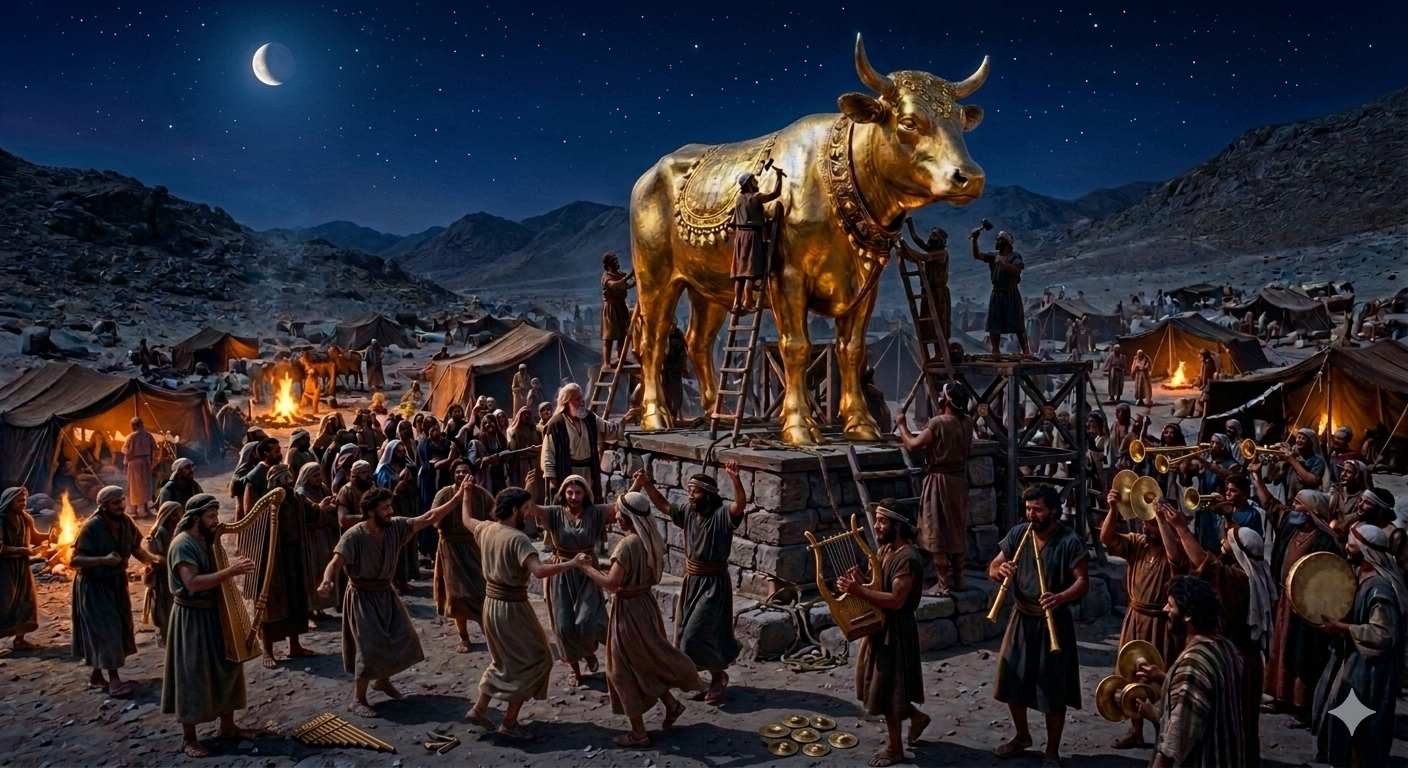
The grave sin of the Golden Calf is one of the best-known stories in the entire Jewish Bible [1]. However, one of the most important and lesser-known aspects of this narrative is the respective roles of the Israelite men and women. When the Jewish people miscalculate the forty days Moses is to spend learning the divine commandments from God, and rashly conclude that Moses has abandoned them, they aggressively demand the construction of the infamous idol.
Stalling for time, Aaron tells the men to “take off the gold rings that are on the ears of your wives, your sons, and your daughters.”[2] As Rashi, the preeminent Torah commentator, explains, Aaron reasons that, “the women and children are protective of their jewelry, perhaps they will object and the matter will be delayed, and in the meantime Moses will come.”[3]
While Exodus next reports that “all the people took off the gold rings that were in their ears and brought them to Aaron,” Rashi elucidates (relying on a midrash and grammatical hints) that “all” refers only to the men, who “did not wait for the women and children to surrender their jewelry; instead, they—the men—removed their own jewelry from themselves.”[4] The women never gave theirs. The plain implication of Rashi’s commentary is that, while the men were all gung-ho to build this idol, the women were either reluctant or refused altogether.
This reading is confirmed in Pirkei de-Rabbi Eliezer, another classic Jewish source:
The women heard [this], but they were unwilling to give their earrings to their husbands; but they said to them: Ye desire to make a graven image and a molten image without any power in it to deliver. The Holy One, blessed be He, gave the women their reward in this world and in the world to come.[5]
The point of this example is not to argue that the world of the Torah comports with modern feminist ideals, but to note that rabbis and scholars are able to cite this and other precedents in arguing for a more egalitarian Judaism that has, outside of insular Orthodox communities, largely prevailed.
________________
[1] See Exod 32:1–4.
[2] Exod 32:3.
[3] Rashi, Commentary on the Torah (Exodus), 32:2.
[4] Rashi, ibid.
[5] PRE, 45:4