
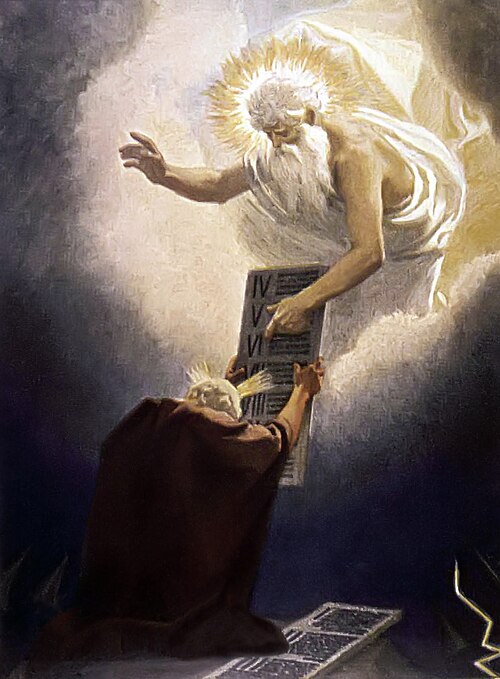
Much of Orthodox Judaism’s deeply conservative, even regressive, character is due to the doctrine of Torah shebe’al peh (the “Oral Law from Sinai”). The central idea here is that the keys for resolving all halakhic questions arising from the Pentateuch’s written text were handed to Moses at Sinai. Of course, it is known as the “Oral Law” because Moses did not record these instructions.
Nevertheless, traditional Judaism bestows divine sanction on the regnant halakhah because it is believed that it was passed down to us in an unbroken chain from Moses to Joshua, Joshua to the Elders, then to the Prophets, to the Talmudic rabbis, then down though the ages to the current generation of poseks (halakhic authorities). Accordingly, if one questions Orthodox leaders regarding why a married Jewish man can unilaterally divorce his Jewish wife, but she lacks the same power, the answer is that this is the existing law, that will stand until there is a consensus of poseks to change it. The same answer will be given regarding the proper manner of observing all rituals.
There are at least three persuasive arguments for rejecting the existence of an unbroken chain of halakhic transmission from the earliest stages of Judaism, in favor of the theory that it was subsequently grafted on. In my book I discuss the first two in depth, so I will just briefly summarize them here.
First, the number of cataclysmic political disruptions in ancient Jewish history make it highly improbable that any fixed set of highly detailed laws could be passed down intact over dozens of generations. Indeed, even the Talmud indicates that after the passing of the great Hillel/Shammai pair of Sages, there was a break in the chain, as the Mishnah in the tractate Pirkei Avot reports for each generation the name(s) of the recipient(s) of this oral tradition and quotes at least one sapiential saying by each Sage. However, for those Sages listed after Hillel and Shammai, it omits the formulaic “[they] received [the oral tradition] from them.” This implies that the author(s) of this tractate believed the chain of transmission had at this point been broken or, minimally, was less trustworthy than before.
Second, there is a scholarly consensus that the doctrine of the Oral Law from Sinai only became established in Amoraic times, meaning in the third century of the Common Era, some two centuries after the Second Temple was destroyed. This invites the question why the earliest generations of Talmudic rabbis did not uphold this principle.
The third reason, perhaps the most interesting, is the surprising lack of support in the Torah itself. In fact, there are at least four instances in which the Pentateuch recounts that Moses and the other leaders are flummoxed by legal questions, which plainly seems anomalous if they are armed with the Oral Law.
The first of these is the complaint brought by certain men who are evidently prohibited under the existing custom from offering the Passover sacrifice at the appointed time because they were ritually impure (perhaps because they came in contact with a corpse while burying the dead in the halakhic manner). When these men approach Moses and Aaron to see if there is not some remedy for this unfair outcome, Moses instructs them to “Stand by, and let me hear what instructions the Lord gives about you.” (Num 9:6-12). God then tells Moses to inform the petitioners that they are permitted to offer the Passover sacrifice and observe the related commandments one month after the established date, a holiday religious Jews now observe as Pesach Sheni (Second Passover).
Moses, Aaron, and the entire community are also unable, without God’s intervention, to determine the proper method of execution for the Sabbath desecrator described in Numbers 15:32–35. Similarly, Moses defers to God on the legal question posed by the daughters of Zelophehad, who protest to him regarding their impending disinheritance. (Num 27:1–7). Without going into the details of this complaint, the Torah reports that “Moses brought their case before the Lord. And the Lord said to Moses as follows: ‘The plea of Zelophehad’s daughters is just,’” and they are granted the requested relief.
Finally, in Leviticus, Moses is baffled by the question of the punishment to be meted out to the blasphemer of the Holy Name. Here again, the Torah reports that, after being brought before Moses, the man “was placed in custody, until the decision of the Lord should be made clear to them,” and subsequently God commands Moses to execute him. (Lev 24:10–14).
In tracing the history of the Oral Law and tradition’s commitment to it, it is necessary to consider contemporaneous events. The first two centuries of the Common Era witnessed not only the unsuccessful “great revolt” against Rome, resulting in an estimated death or exile of up to a million Jews and the destruction of the Second Temple in 70 CE, but the almost equally catastrophic Bar Kochba revolt that began in 132 CE. Obviously, the Romans were intensely hostile to Judaism, and some Jews may have been tempted to abandon its practice. Under such circumstances, it would have been natural for the Talmudic rabbis to enshrine the laws and rituals they followed by assigning them divine status.
This period also, of course, saw the emergence of Christianity in Eretz Israel. Initially just a rival sect to Rabbinic Judaism, Christianity was clearly attractive to a sizable number of Jews, and the Rabbis may have felt the need to draw a bright and unambiguous line between what were doctrinally acceptable beliefs and customs, and heretical ones. This rupture was just coming to the fore in the second century, but the threat to Judaism posed by this movement would continue for centuries.
It must be emphasized that at the start of the third century, the majority of Jews lived in the diaspora; that is, in various parts of North Africa, the Roman Empire and Babylonia (where the more authoritative of the two Talmuds was authored). These far-flung communities had developed their own laws and customs regulating Jewish life. While it is certainly understandable that under the exigent circumstances they faced, the Talmudic rabbis would attempt to enforce uniformity, it had the unfortunate side effect of destroying the healthy pluralism then in effect. This trend would only accelerate in the Middle Ages.
To avoid a complete misunderstanding of Rabbinic Judaism, it must be said that, despite the notion of Torah shebe’al peh, the Talmud records many examples of halacha being modified and even nullified in the interests of justice. I discuss one prominent example in my previous blog post. Even so, as demonstrated by the absolutely appallingly illiberal halakhic decisions made by the Israeli Rabbinate, this doctrine continues to exert a malign influence. In my book I discuss the origin and consequences of the Oral Law from Sinai in much greater depth in the course of arguing that authentic Judaism is open-minded, tolerant, pluralistic, and innovative.
Leave a Reply